


GM Had a Version of OnStar in 1966?!?!
Most people in the world are familiar with the wide range of new technologies included in modern cars.
These days, new vehicles come with everything including central computer systems, RemoteLink, Intellilink, digital dashboards and even integrated entertainment platforms.
It’s very different from the cars sold just a few decades ago which were largely devoid of advanced electronics. Wireless systems like OnStar were something many drivers thought of as science fiction in the 1960s. The truth, however, is that General Motors (GM) was already developing one of these systems as early as 1966.
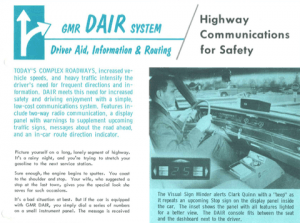
The Driver Aid, Information and Routing (DAIR) system was introduced in 1966 decades before GM would develop OnStar. The DAIR system was a large box that sat on top of the dashboard in front of the driver. The box contained a radio transmitter, a receiver and a microprocessor. It was intended to be a driving assistance system very similar to the global positioning systems (GPS) everyone is familiar with today. It also had equipment which allowed for emergency signaling long before cell phones and mobile communication were in widespread use.
One of the clear similarities between DAIR systems and OnStar is the capability to send or receive emergency messages while on the road. The circuitry in the DAIR box was able to encode messages and broadcast them on radio channels to receivers in nearby service centers. There was even a small rotary telephone dial on the front. A driver who became stranded on the road could place an emergency call for assistance. The radio signal was carried and encoded by transmitters located along the side of the road. The service center could even send a voice confirmation back to the driver.
The truly revolutionary concept in the DAIR system was the route minder. Engineers at GM envisioned the route minder as an automated system that would guide a driver safely along a predetermined route to a set destination. The route minder was a clear predecessor to the real-time navigation and GPS technology in common use today. The DAIR box did not have a screen. It used a series of audio signals and colored lights to communicate to the driver.
A driver would program the DAIR system to follow a particular route by inserting a punch card into the device. The DAIR did not use satellites. It relied on magnets at intersections and radio transmitters on the roadside. The magnets allowed the device to indicate turns to the driver. The transmitters allowed the DAIR to communicate real-time hazards and road conditions.
The DAIR system was tested by journalist Walter Cronkite in 1966. GM never put the system into widespread production. It is believed it only appeared in two cars. Similarly, the network of magnets and transmitters was never fully realized. The late 1960s and early 1970s actually saw the development of more practical routing and fleet management systems that eclipsed DAIR.

0 comment(s) so far on GM Had a Version of OnStar in 1966?!?!